
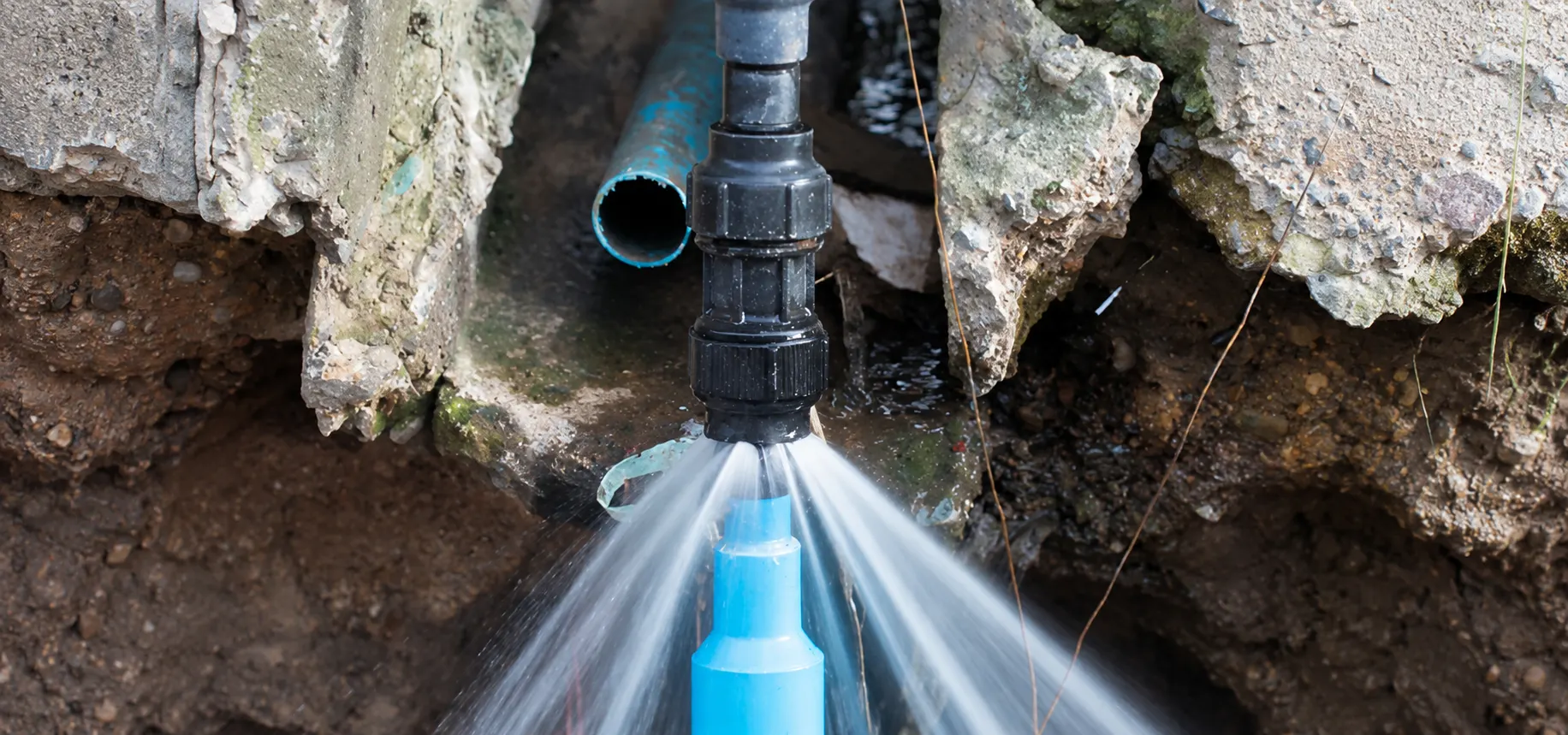
Drain repair in Dubai
Cleaning cannot fix a broken pipe. This is the page for the problems that need repairing.
Quick answer
What is drain repair?
Drain repair fixes structural faults in a drainage line: cracks, fractures, displaced or open joints, deformation, back-fall and collapse. Unlike drain cleaning, which removes what is inside a sound pipe, repair restores a pipe that has failed. The defect is located by CCTV survey before any work is priced.
Cleaning versus repair: the distinction that saves the most money
Drainage faults divide cleanly into two families. One is solved by cleaning. The other is solved by repair. Spending cleaning money on a repair problem is the most common way a Dubai drainage bill doubles.
A service fault is something in the pipe that should not be there: grease, scale, sand, a foreign object, roots. Remove it and the pipe is as good as it was. A structural fault is something wrong with the pipe itself: a crack, a moved joint, a length laid at the wrong fall, a collapse. Cleaning does not touch these, and on a cracked or displaced line, high-pressure cleaning makes them worse.
The tell is repetition. A drain that blocks once has a blockage. A drain that blocks in the same place three times has a defect, and each clearance is money spent postponing the survey that would identify it. If that describes your line, the next thing to buy is a CCTV survey, not another clearance.
The structural faults we repair
Cracks and fractures
A crack lets water out and roots and soil in. Left alone it grows, the surrounding ground washes into the pipe, and a hairline fault becomes a collapse. Small cracks in otherwise sound pipe are often relined. Fractured sections usually need replacing.
Displaced and open joints
A joint that has moved leaves a step or a gap that catches everything passing and lets roots in. It is the single most common cause of a recurring blockage in one fixed location, and it is invisible from the surface. Depending on severity, the answer is relining, a localised patch, or excavation and rejointing.
Back-fall
A section laid so it runs uphill, or falls too gently for solids to be carried. Water passes, solids settle, and the line blocks at the same point no matter how often it is cleaned. It is a construction defect. The only real fix is relaying that section to the correct gradient, which is drain installation work.
Collapse
Partial or total loss of the pipe bore, from age, ground movement, or a crack left to grow. A partial collapse can sometimes be relined. A total collapse must be excavated and replaced. This is where a defect that could have been a patch becomes a trench across a driveway, which is the argument for surveying early.
Repair methods, from least to most disruptive
| Method | What it suits | Disruption |
|---|---|---|
| Patch lining | A single crack or joint in otherwise sound pipe | None. Installed from an access point |
| Full relining | A run with several defects but intact line and level | None to the surface. See relining |
| Localised excavation | One collapsed or fractured section | A single dig at a located point |
| Relaying | Back-fall, or a run beyond relining | The affected length is opened and re-laid |
| Replacement | Total collapse, or pipe past its service life | The most, and sometimes unavoidable |
The method follows the survey. Where a fault can be repaired from inside the pipe, we reline rather than dig. See sewer pipe relining for how trenchless repair works and when it is the right call. Where the line must be opened, a located survey means one dig in the right place rather than exploratory trenching.
What drives the cost of a drain repair
- The nature of the fault. A single patched joint and a collapsed run are different orders of work.
- Whether the repair can be done trenchless. Relining avoids excavation, reinstatement, and the argument with whoever owns the surface above the pipe.
- Depth and location. A shallow pipe under a garden bed and a deep line under a tiled driveway or a road differ enormously once excavation is involved.
- Reinstatement. Breaking a surface is half the job. Putting back tile, block paving or a road to its original condition is the other half.
- Access and permits. Work affecting a shared or public drain, or a line in a free zone development, may need coordination and a permit before anyone digs.
We do not quote a repair before a located survey, because a price given without measuring the fault is corrected upward on site every time.
What we see go wrong
Jetting a line that needed repair. Pressure applied to a cracked or displaced pipe opens the defect and turns a patch into an excavation. It is the reason we survey before we clean, every time.
Digging before locating. Exploratory excavation to find a fault a camera could have pinpointed is expensive, and it is expensive in someone's driveway. A located survey means one dig, in the right place, to the right depth.
Repairing the symptom and leaving the cause. Cutting roots without addressing the joint they entered through, or clearing a blockage without correcting the back-fall causing it, guarantees a return visit on a shortening interval.
Frequently asked questions
How do I know if my drain needs repair or just cleaning?
The reliable signal is repetition. A drain that blocks once and clears usually had a blockage. A drain that blocks repeatedly in the same location usually has a structural defect: a displaced joint, back-fall, scale or a partial collapse. Cleaning relieves the symptom; only a located CCTV survey tells you which fault you actually have and therefore whether cleaning or repair is the right spend.
Can a drain be repaired without digging?
Often, yes. A single crack or displaced joint in otherwise sound pipe can be patch lined from an access point, and a run with several defects can be fully relined, both without excavation. Digging is required for a total collapse, for back-fall that needs relaying to the correct gradient, and for pipe that is past its service life. The survey decides which applies.
Why does my drain block in the same place every time?
A blockage that recurs at one fixed point is almost always a structural fault catching debris: a displaced joint leaving a step in the bore, a section of back-fall where solids settle, or scale narrowing the pipe. Clearing it treats the symptom and it returns. The location is a clue, and a camera survey of that exact point identifies the fault so it can be repaired once.
Is a cracked drain pipe urgent?
It is not usually an emergency, but it does not improve on its own. A crack lets water escape into the surrounding ground and lets soil and roots into the pipe, so a small fault grows and the ground around it can wash away. Repairing a crack while it is small is a patch. Repairing it after it has become a collapse is an excavation.
Do you repair shared or public drains?
We repair the private drainage that serves your property. Where a fault sits on a shared line or connects to the public network, responsibility and the approval route change, and we will tell you which applies after the survey rather than beginning work on a drain that is not yours to open.
Where can I find drain repair near me?
The honest version of near me is about response time, not distance on a map. We provide drain repair across Dubai, working from our base in Al Quoz Industrial Third, so a near me search is answered less by a branch on your street and more by how quickly we can reach you. That depends on where you are in the city, the time of day and access, so rather than claim to be the nearest, we ask where you are and give you a realistic time to attend. Tell us your location and what you need, and we will be straight about when we can be there.
Related pages
Contact
Tell us about the fault
A drain that blocks in the same spot, a smell that will not clear, a wet patch in a garden, or a survey that has already found a defect. Tell us what you know.
Phone
+971 56 864 8994
Email
info@jetdrainpro.com
Get the defect located before you get it quoted
Nobody can price a repair to a fault they have not measured. Tell us what the line is doing and we will start with a survey.