
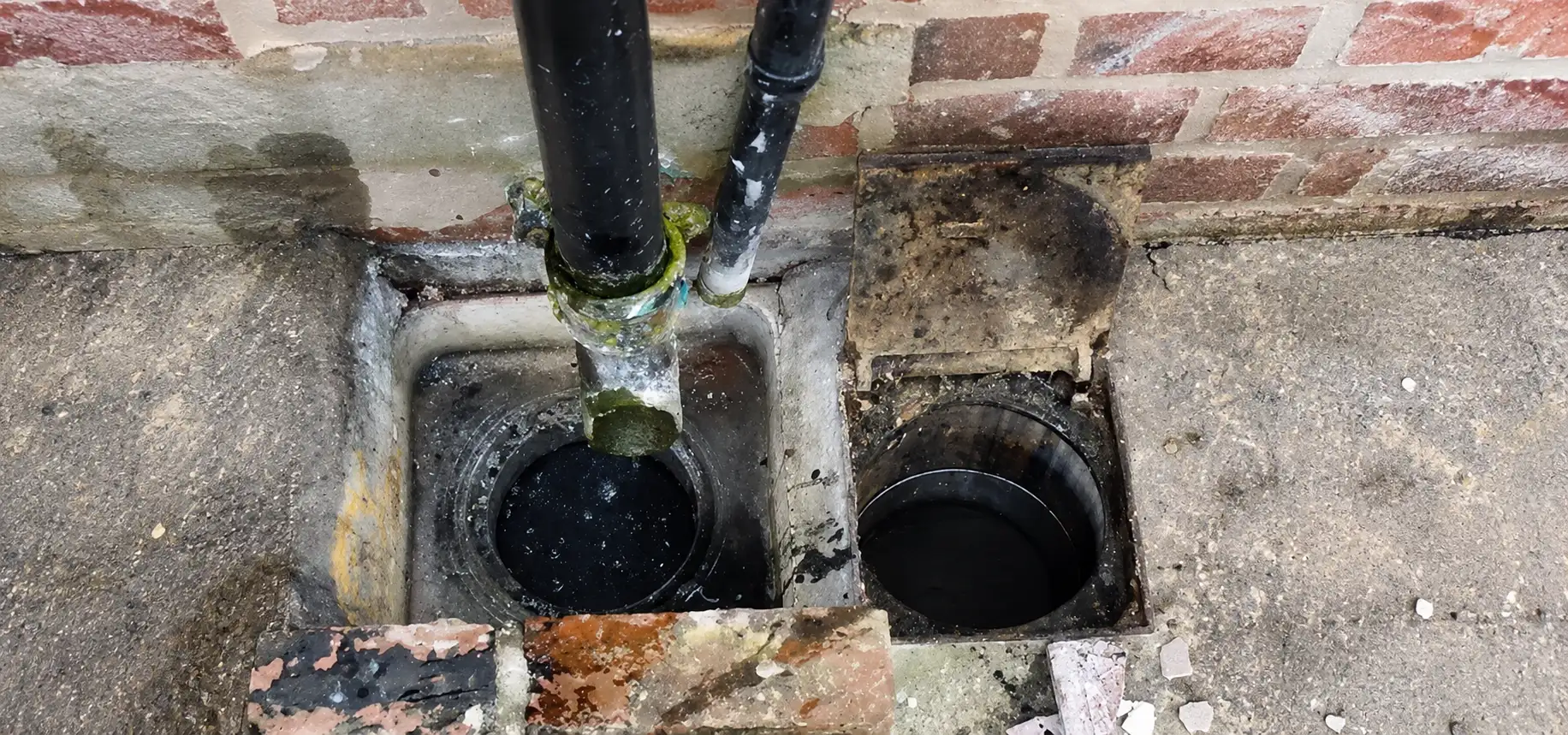
Hydro jetting in Dubai
The method that removes the pipe wall coating rather than boring a hole through it.
Quick answer
What is hydro jetting?
Hydro jetting is a drain cleaning method that uses water at high pressure to scour the full circumference of a pipe wall, removing grease, mineral scale, sand, sludge and root intrusion. It restores the original bore of the pipe rather than clearing a channel through the blockage.
How hydro jetting works
A jetting unit pressurises water and delivers it through a hose to a nozzle sized for the pipe. The nozzle carries rear-facing jets that both propel it up the line against the flow and cut into the material coating the wall. Forward-facing jets, where fitted, break through a solid plug. Debris is carried back toward the access point, where it is recovered rather than pushed downstream.
For a plain explanation of the method from the start, see what is hydro jetting, and for how to tell your line needs it, the signs you need hydro jetting. The important word is circumference. A drain cable is a mechanical tool that finds the softest path, which is the middle of the blockage. Water under pressure has no such preference. It reaches the wall at every point around the pipe, which is why jetting is the only common method that removes a grease coating instead of drilling through it.
Pressure alone is not the specification. Flow rate determines how much material can be carried out, nozzle geometry determines what the jets actually do, and both must be matched to pipe diameter and material. A nozzle correct for a 150 mm cast iron sewer will damage a 40 mm plastic waste line. Any contractor who quotes only a pressure figure is describing a pump, not a method.
When hydro jetting is right, and when it is the wrong answer
Jetting is the correct method for grease, mineral scale, sand and silt, soft sludge, and root intrusion where a rotary cutting nozzle is used. It is also the correct method when a line has been cabled repeatedly and keeps returning, because a returning blockage usually means the wall coating was never removed.
Jetting is the wrong method, and can be an expensive mistake, in three situations.
- The pipe is already damaged. A hairline crack, a displaced joint, or a section that has begun to collapse will be made worse by water at pressure. This is not a marginal risk. It is the single most common way a drainage problem becomes an excavation.
- The pipe is a material or age that will not take the pressure. Older thin-wall plastics and corroded cast iron need a reduced specification or a different method entirely.
- The obstruction is a solid object rather than a coating. Jetting will move it. It will not always retrieve it, and moving a foreign object further into a sewer is not progress.
All three are found by a camera and none are found by a pressure gauge. This is why every jetting job we attend begins with a CCTV survey, and why we will decline to jet a line the camera shows as compromised. A compromised line needs drain repair or relining, not water.
Our hydro jetting process
Inspection
A camera is passed through the line from the nearest access. We locate the restriction, measure its distance from the access point, and assess the pipe wall on both sides of it.
Diagnosis
We identify the material and the condition of the pipe. This determines nozzle, pressure and flow. It also determines whether jetting is appropriate at all.
Equipment setup
Nozzle and pressure are selected for pipe diameter and material. Access points are protected, containment is set for recovered material, and the working area is isolated where a chamber must stay open.
Cleaning
The line is worked from the access toward the restriction and beyond it, so the full run is treated rather than only the plug. Debris is recovered at the access point, not flushed into the next section of the network.
Testing
The line is flow-tested under load, then re-surveyed along the cleaned section to confirm the bore is restored and the wall is intact.
Final report
You receive the before and after footage, the pipe condition, what was removed, and any defect the cleaning did not address, with our recommendation.
What drives the cost of hydro jetting
We do not publish a price list. A price quoted before a survey is a guess wearing a quote's clothing, and the guess is always corrected upward on site. These are the factors that move the number. Most of them you can assess yourself before you call.
- Pipe diameter and length. A 50 mm kitchen waste and a 200 mm underground main need different equipment, different nozzles and different amounts of time.
- The material being removed. Softened sludge is quick. Hardened grease across a long restaurant run, or mineral scale laid down over fifteen years, is not.
- Pipe condition. A sound line can be worked at full specification. A line with existing damage must be worked cautiously, or not at all, which changes the job into a repair.
- Accessibility. An external chamber at ground level, a rodding eye behind a fitted kitchen, and a line reachable only by lifting tiled floor are three different jobs at the same pipe diameter.
- Whether a survey is required. We include one by default. If you already hold a recent and readable survey of the same line, that step can be shortened.
- Emergency or out-of-hours attendance. A callout at 02:00 to a sewage backup carries a different rate from a booked morning appointment.
- Water supply and containment. A site with no accessible supply, or one where recovered material must be tankered away rather than discharged, adds equipment and time.
Hydro jetting compared with the alternatives
Three methods are commonly offered for the same symptom. They do different things, and the difference decides whether you call again in four months.
| Consideration | Hydro jetting | Mechanical cabling | Chemical cleaner |
|---|---|---|---|
| What it removes | The full circumference of material on the pipe wall | A channel through the centre of the blockage | Soft hair and soap close to the outlet |
| Hardened grease | Removed | Bored through, coating remains | Not affected |
| Mineral scale | Removed with the correct nozzle | Largely unaffected | Not affected |
| Sand and silt | Flushed and recovered | Redistributed rather than removed | Not affected |
| Roots | Cut and cleared with a rotary nozzle | Broken and partially retrieved | Not affected |
| Solid obstruction | Moved, not always retrieved | Broken and retrieved | Not affected |
| Safe on a damaged pipe | No. Pressure will open a crack or a joint | Cautiously, at low torque, as a temporary measure | No. Heat and caustic attack older plastics |
| Leaves the line safe for the next technician | Yes | Yes | No. Residual caustic is a hazard when the trap is opened |
| Best treated as | Restorative and preventive | Reactive and diagnostic | A last resort near the outlet, and rarely that |
The pattern is simple enough to hold in your head. Cabling gets flow back today. Jetting gets the pipe back. Chemicals get you a hazard and a bill. For the long comparison, see hydro jetting versus drain snaking.
What Dubai drains are actually full of
Drainage here fails in ways a contractor trained in a temperate climate does not expect, and the failure mode determines the nozzle.
Grease
Kitchen waste leaves a food outlet warm and liquid. It cools inside the run and hardens against the wall. In a high-rise stack in Business Bay or JLT, forty floors of domestic kitchen waste converge into one horizontal run, and that run is where grease accumulates. The line above it is usually fine. The horizontal is not.
Mineral scale
Hard water lays scale on the pipe wall in a thin annual layer. Nobody notices, because nothing blocks. Then a line that was 100 mm behaves like a line that is 70 mm, flow slows, solids settle where they never used to, and what presents as a blockage is a bore problem fifteen years in the making. A cable will polish scale. It will not remove it.
Sand
Fine construction and desert sand enters through open gullies, balcony drains, unsealed inspection chambers and any gap left by a trade that came after the drainage was signed off. It travels until the fall flattens, then stops. In Al Quoz and Al Barsha it is the first thing we look for. Cabling redistributes sand. Jetting flushes it back to the chamber where it can be recovered.
Roots
In villa communities with mature landscaping, roots find joints. They do not break sound pipe. They exploit a joint that has already moved, which means a root intrusion is nearly always evidence of a second, structural problem behind it. Cutting the roots and leaving the joint guarantees a return visit.
What we see go wrong
Three mistakes account for most of the avoidable drainage spend we encounter.
Jetting a pipe nobody looked at. Water at working pressure applied to a cracked line turns a repair into an excavation. The survey that would have prevented it costs a fraction of the reinstatement.
Repeat cabling of a recurring blockage. Each visit is cheap. Six are not, and at the end of them the coating is still on the wall and the defect, if there is one, has grown. If a drain has been cleared three times in a year, stop clearing it and look at it.
Cleaning the line and ignoring the grease trap. In a commercial kitchen the trap is the control point. A line jetted downstream of a failing trap will foul again on the schedule the trap sets, not the schedule the contract sets. See grease trap regulations in Dubai for what is required of food outlets.
On prevention, the useful interval is the one the first survey suggests, not the one printed on a maintenance template. A restaurant with a high fryer load and a long horizontal run needs a different schedule from a coffee shop with two sinks. That is what an annual drain maintenance contract should be built around.
Frequently asked questions
Is hydro jetting safe for my pipes?
On a structurally sound pipe, with a nozzle and pressure matched to its diameter and material, yes. On a pipe that already has a crack, a displaced joint or advanced corrosion, no. Pressure will open the existing defect. This is why the survey comes first and why we will decline to jet a line the camera shows as compromised.
How is hydro jetting different from drain snaking?
A drain cable is a mechanical tool that bores a channel through the middle of a blockage, restoring flow while leaving the coating on the pipe wall. Hydro jetting uses water at pressure to scour the full circumference, removing the coating and restoring the original bore. Cabling gets flow back today. Jetting gets the pipe back.
How often should a commercial kitchen be jetted?
The interval should be set by what the first survey finds, not by a calendar. Grease loading varies enormously between a fryer-heavy kitchen and a coffee shop, and the length and fall of the horizontal run matters as much as the menu. Quarterly is a common starting point for a busy food outlet, then adjusted once you have two surveys to compare.
Will hydro jetting remove tree roots?
A rotary cutting nozzle will cut roots out of a line. It will not fix the reason they got in. Roots enter through joints that have already moved, so a root intrusion is usually evidence of a structural defect. Cutting the roots without addressing the joint means they return, and the interval gets shorter each time.
Do I need a CCTV survey before hydro jetting?
We include one, because the three conditions that make jetting the wrong choice, a damaged pipe, an unsuitable pipe material, and a solid foreign object, are all invisible from the surface and all found by a camera. If you hold a recent readable survey of the same line, tell us and that step can be shortened.
Can hydro jetting be used inside an occupied building?
Yes. The work is contained at the access point and recovered material is captured rather than discharged. Occupied high-rise and hotel work is normally scheduled around service hours, and we agree isolation of the affected stack with the building's facilities team before attending.
Is there a hydro jetting service near me in Dubai?
In practical terms, near me means we can reach you. We provide hydro jetting across Dubai, working from our base in Al Quoz Industrial Third, so a near me search is answered less by a branch on your street and more by how quickly we can reach you. That depends on where you are in the city, the time of day and access, so rather than claim to be the nearest, we ask where you are and give you a realistic time to attend. Tell us your location and what you need, and we will be straight about when we can be there.
Related pages
Contact
Ask about hydro jetting
Recurring blockages, a restaurant line that slows every few weeks, or a survey that has already found scale. Tell us what you know and we will tell you what we would check.
Phone
+971 56 864 8994
Email
info@jetdrainpro.com
Book a survey before you book a jet
Tell us the building and what the line is doing. If jetting is the wrong method we will say so before anyone is dispatched.