
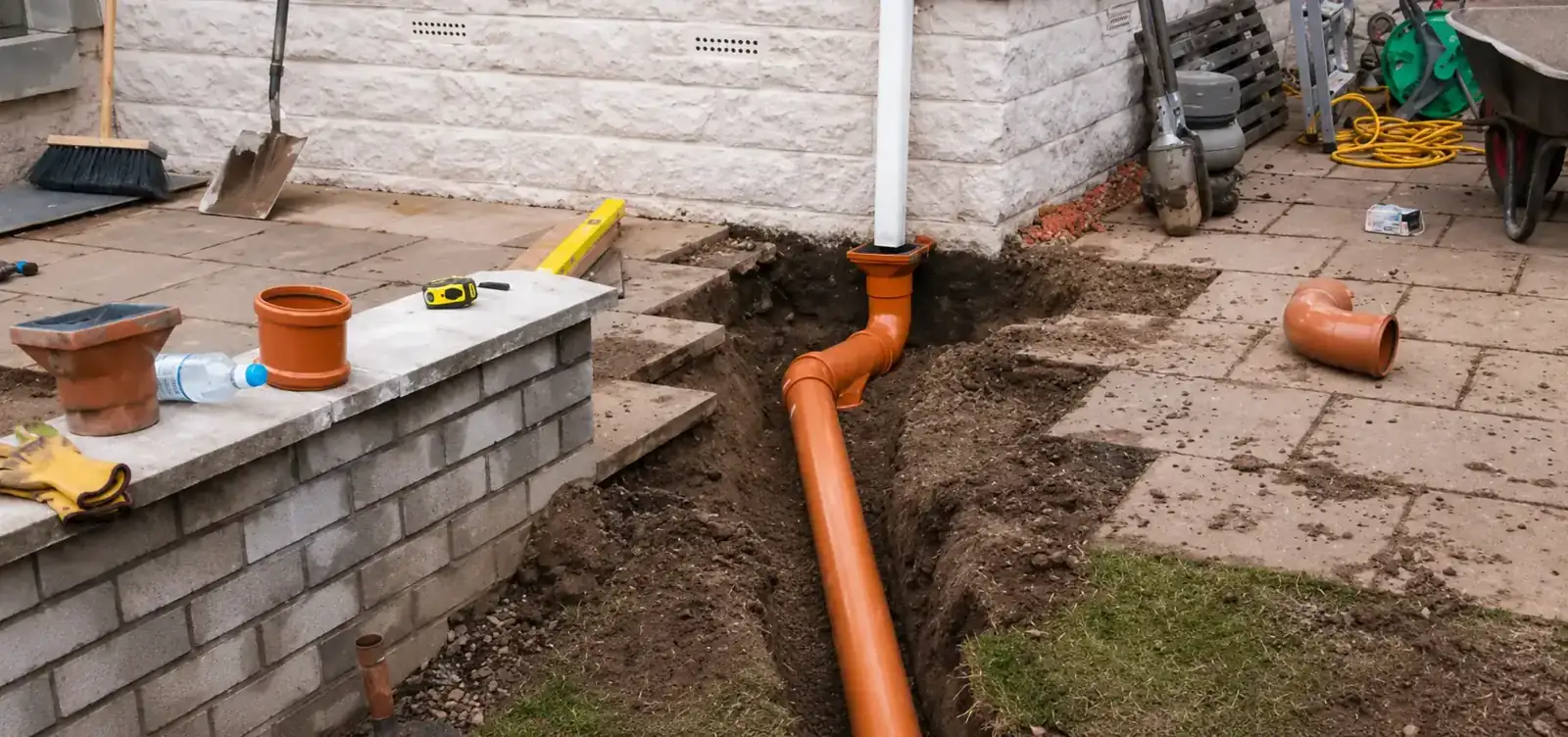
Drain installation in Dubai
The one drainage job you cannot inspect after it is buried, so it has to be right before.
Quick answer
What does drain installation involve?
Drain installation is laying new drainage or sewer pipework: setting out the route and gradient, selecting pipe material and diameter for the load, bedding and jointing the pipe, connecting it to the network, and testing the run before it is backfilled. The gradient is the part that most often decides whether it works.
Why fall is the whole job
A drain works because water and solids run downhill at the right speed. Too shallow a fall and solids settle instead of being carried, so the line silts and blocks, forever, no matter how well it was built otherwise. Too steep and the water outruns the solids, leaving them stranded, with the same result. There is a correct range, and hitting it along the whole run is most of what installation is.
This is why a badly installed drain cannot be cleaned into working properly. Back-fall, the fault where a section runs uphill or falls too gently, is a construction defect, and the only real remedy is to dig it up and lay it again. Every silted, endlessly blocking line we relay was installed by someone who treated fall as an afterthought. Getting it right once is far cheaper than getting it wrong and paying to clean the consequence for years.
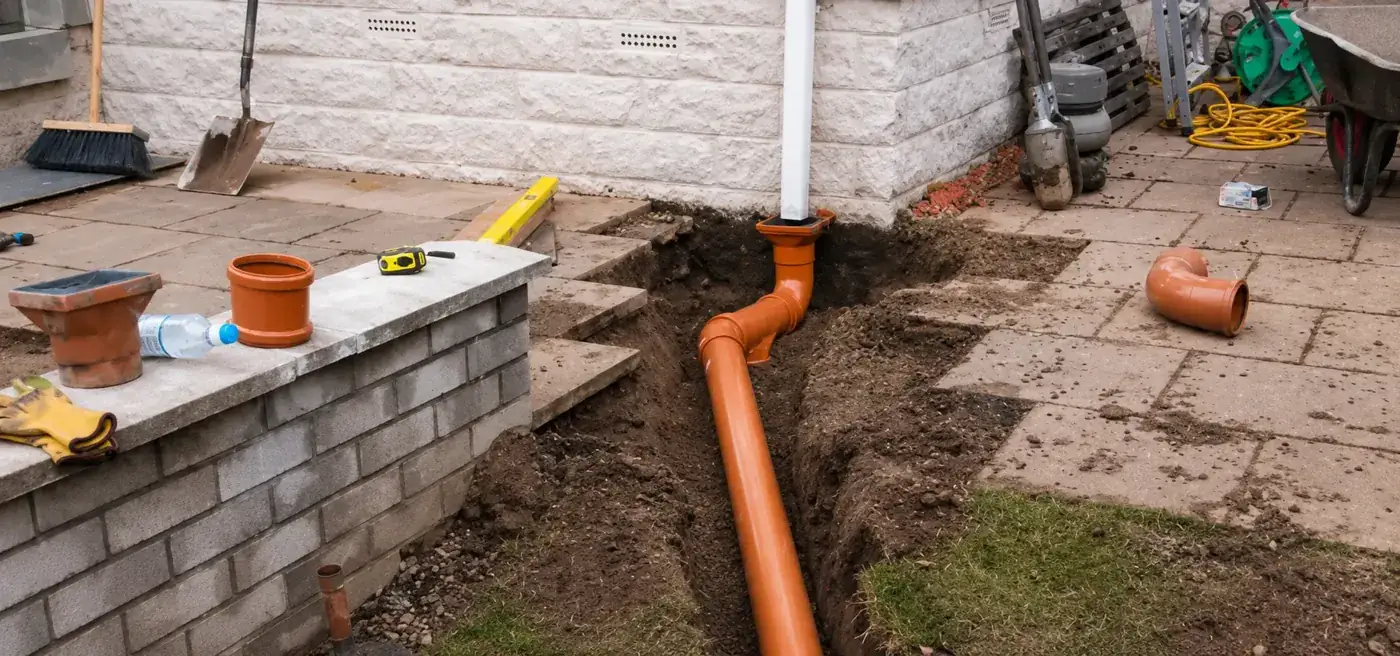
What a proper installation includes
Set out
The route and gradient are established before anything is dug, accounting for the connection point, the fall available, and what the line has to pass under or around.
Material and size
Pipe material and diameter are selected for the load and the setting. The common choices are covered below.
Excavation and bedding
The trench is dug to depth and the pipe is bedded on a prepared granular base, so it is supported evenly along its length rather than bridging hard points that would crack it.
Jointing
Pipes and fittings are jointed to the manufacturer's method. A bad joint is a future displaced joint, which is a future recurring blockage.
Access
Inspection chambers and rodding eyes are set where the line changes direction or gradient, so the finished drain can be surveyed and cleared without excavation.
Test, then cover
The run is CCTV surveyed and flow tested before backfilling. This is the one and only chance to confirm the fall and the joints while they can still be seen. Then, and only then, it is covered.
Pipe materials, and where each belongs
| Material | Typical use | Note |
|---|---|---|
| uPVC | Above and below ground domestic drainage | Light, easy to joint, the common default for waste and soil |
| HDPE | Below ground, and where movement is expected | Tough, flexible, welded joints, good where ground moves |
| PPR | Hot and cold pressurised supply | A supply material, not a gravity drainage one; named here because it is often confused |
| Cast iron | Older buildings, and where fire or acoustic rating matters | Durable and quiet, heavier and more expensive to work |
Matching material to duty matters as much as fall. A supply material used for gravity drainage, or a thin-wall pipe used where the ground moves, is a defect built in at day one. If you are installing new drainage, this is the kind of decision worth getting right on paper before it is ordered.
What drives the cost of drain installation
- The length of the run and the number of connections, chambers and changes of direction.
- Depth. A deep line means more excavation, more spoil to remove, and more reinstatement.
- Ground and surface. Digging through sand is one thing; breaking and reinstating a tiled or paved surface is another.
- Pipe material and diameter, set by the load the line must carry.
- Access and permits, particularly where the new line connects to a shared or public network, or sits within a free zone development.
- Testing and records, which a proper job includes and a cheap one skips, to your later cost.
The one place not to save money is the survey and test before backfilling. It is a small fraction of the job and it is the only moment the work can be checked. See drain installation cost factors.
Frequently asked questions
What is the correct fall for a drain?
There is a standard range for domestic gravity drainage that balances carrying solids against outrunning them, and it varies with pipe diameter: smaller pipes need a slightly steeper fall than larger ones. The number matters less than the principle, which is that the gradient must stay within range along the whole run. A line that meets the fall on average but dips in the middle will still block at the dip.
Should new drainage be CCTV tested before it is covered?
Yes, and it is the single most valuable step in the job. Once a drain is backfilled, the fall and the joints cannot be seen without digging it up again. A CCTV survey and flow test before covering is the only opportunity to confirm the line was built correctly, and it costs a fraction of discovering a fault after the surface has been reinstated over it.
Can you re-route drainage around an extension?
Yes. Re-routing a line to clear new foundations or an extension is common work, and the constraints are the same as any installation: maintaining fall along the new route, jointing properly, and keeping access at changes of direction. The route is planned around the fall available, because the fall is not negotiable and the route usually is.
What pipe should be used for underground drainage in Dubai?
uPVC is the common default for below-ground gravity drainage, with HDPE preferred where ground movement is a consideration because its welded joints tolerate flexing. The right answer depends on the load, the depth and the setting, and it is a decision worth settling before ordering. PPR, which comes up often, is a pressurised supply material and is not used for gravity drainage.
Do I need approval to install new drainage?
Work connecting to a shared or public network, and work within certain developments, needs coordination and approval before it proceeds, and the route differs between Dubai Municipality areas and free zones. We establish which applies to your building at the planning stage, so approvals run alongside the work rather than halting it.
Is drain installation available near me?
Near me is a fair thing to search for, and here is how it works with us. We provide drain installation across Dubai, working from our base in Al Quoz Industrial Third, so a near me search is answered less by a branch on your street and more by how quickly we can reach you. That depends on where you are in the city, the time of day and access, so rather than claim to be the nearest, we ask where you are and give you a realistic time to attend. Tell us your location and what you need, and we will be straight about when we can be there.
Related pages
Contact
Tell us about the project
A new build, an extension, a re-route around new work, or a failed line that needs replacing. Tell us the building and what it has to drain.
Phone
+971 56 864 8994
Email
info@jetdrainpro.com
Planning new drainage? Start before the trench is dug
The cheapest time to get drainage right is before it is buried. Tell us what you are building and we will tell you what the run needs.