
Hydro jetting vs drain snaking
One clears a path. The other clears the pipe. The difference decides whether you call again.
Quick answer
What is the difference between hydro jetting and drain snaking?
Drain snaking drives a cable through a blockage to clear a channel and restore flow. Hydro jetting uses high-pressure water to scour the full pipe wall, removing the grease and scale coating rather than boring through it. Snaking gets flow back quickly; jetting restores the pipe and lasts longer.
The short version
If you take one thing from this guide, take this. A drain snake is a mechanical cable that punches a hole through a blockage. Hydro jetting is pressurised water that cleans the whole inside surface of the pipe. Snaking is faster and cheaper per visit and leaves the pipe wall coated. Jetting costs more per visit and leaves the pipe genuinely clean. If a drain blocks once, snake it. If it blocks again and again, the coating is the problem and it needs jetting.
What each one actually does
Drain snaking
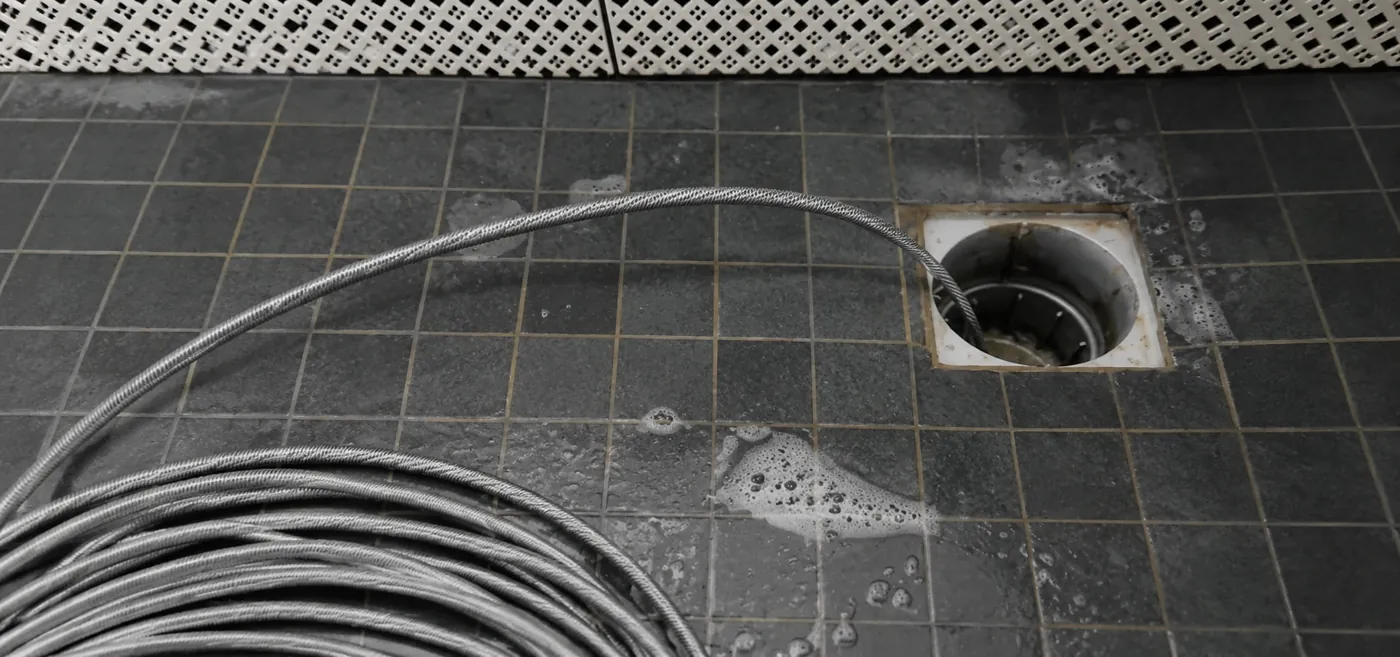
A flexible steel cable is driven down the line by a drum machine, with a head that breaks or retrieves the obstruction. Because the cable follows the path of least resistance, it goes through the softest part of the blockage, which is the middle. That restores flow, and for a solid plug or a retrievable object it is exactly the right tool. What it does not do is touch the material coating the pipe wall around the hole it made. That coating is still there, and it is what the drain will re-block on.
Hydro jetting
Water at high pressure is delivered through a nozzle sized to the pipe. Rear-facing jets pull the nozzle up the line and scour the wall; the water reaches every point around the circumference, not just the centre. That removes the coating, the grease, the scale and the sand, and returns the pipe to its original bore. It is the only common method that cleans the wall rather than the path.
Side by side
| Consideration | Hydro jetting | Drain snaking |
|---|---|---|
| Clears the blockage | Yes | Yes |
| Removes grease from the wall | Yes | No, bores through it |
| Removes scale | Yes, correct nozzle | No |
| Removes sand and silt | Yes, flushed out | No, redistributed |
| Retrieves a solid object | Not always | Yes |
| Cuts roots | Yes, rotary nozzle | Partially |
| Time before it re-blocks | Long, bore restored | Short if grease or scale remain |
| Safe on a damaged pipe | No, pressure opens defects | Cautiously, low torque |
| Cost per visit | Higher | Lower |
| Cost across a year of a grease line | Lower, one visit lasts | Higher, repeated visits |
How to tell which you need
The history tells you more than the symptom. A drain that has never blocked before and blocks suddenly probably has a discrete obstruction: snake it, and if a camera confirms the pipe is otherwise clean, that is the end of it. A drain that blocks repeatedly, slows gradually, or serves a kitchen or a busy shared line almost certainly has a wall coating: jetting is what clears it and keeps it clear.
There is one case where neither is the answer. If the drain blocks in the same place every time, the problem is not what is in the pipe but the pipe itself: a displaced joint, a crack, or back-fall. No method that cleans the inside will fix a fault in the pipe, and jetting a damaged pipe makes it worse. That is why we put a camera on a recurring blockage before choosing a tool, and it is the whole argument of the drain cleaning approach: look first, then pick the method the pipe needs.
Frequently asked questions
Is hydro jetting better than snaking?
Neither is better in general; they do different jobs. Snaking is the right tool for a sudden blockage or a retrievable object, and it is cheaper per visit. Jetting is the right tool for grease, scale, sand and recurring blockages, because it cleans the pipe wall rather than boring a hole through the obstruction. The better method is the one that matches what is actually in your pipe, which is why a camera check settles it.
Will snaking fix a grease blockage permanently?
No. A cable bores a channel through a grease blockage and restores flow, but it leaves the grease coating on the pipe wall, so the line narrows and blocks again, often within weeks. Grease is removed, not bored through, by hydro jetting. If a greasy kitchen line has been snaked repeatedly and keeps returning, jetting is what breaks the cycle.
Can I snake or jet a drain myself?
A small hand auger can clear a simple local blockage in a sink or toilet. Beyond that, both methods can cause damage in untrained hands: a powered snake can crack a fitting or lodge in a joint, and pressurised jetting will open a defect in a pipe that is not sound. More to the point, neither tells you whether the pipe is sound in the first place, which is the thing a camera survey is for.
Which is cheaper, jetting or snaking?
Snaking is cheaper per visit. Jetting is often cheaper across a year, because on a grease or scale line one jetting visit lasts where snaking has to be repeated. The real comparison is not the price of a single visit but the cost of keeping the drain working, and for a recurring blockage that usually favours jetting.
Where can I find hydro jetting vs drain snaking near me?
The honest version of near me is about response time, not distance on a map. We provide hydro jetting vs drain snaking across Dubai, working from our base in Al Quoz Industrial Third, so a near me search is answered less by a branch on your street and more by how quickly we can reach you. That depends on where you are in the city, the time of day and access, so rather than claim to be the nearest, we ask where you are and give you a realistic time to attend. Tell us your location and what you need, and we will be straight about when we can be there.
Related pages
Contact
Ask which method you need
Tell us what the drain is doing and how often. That history is usually enough to point to one method or the other.
Phone
+971 56 864 8994
Email
info@jetdrainpro.com
Not sure which your drain needs?
Describe the symptom and the history and we will tell you which method fits, after a look inside.