
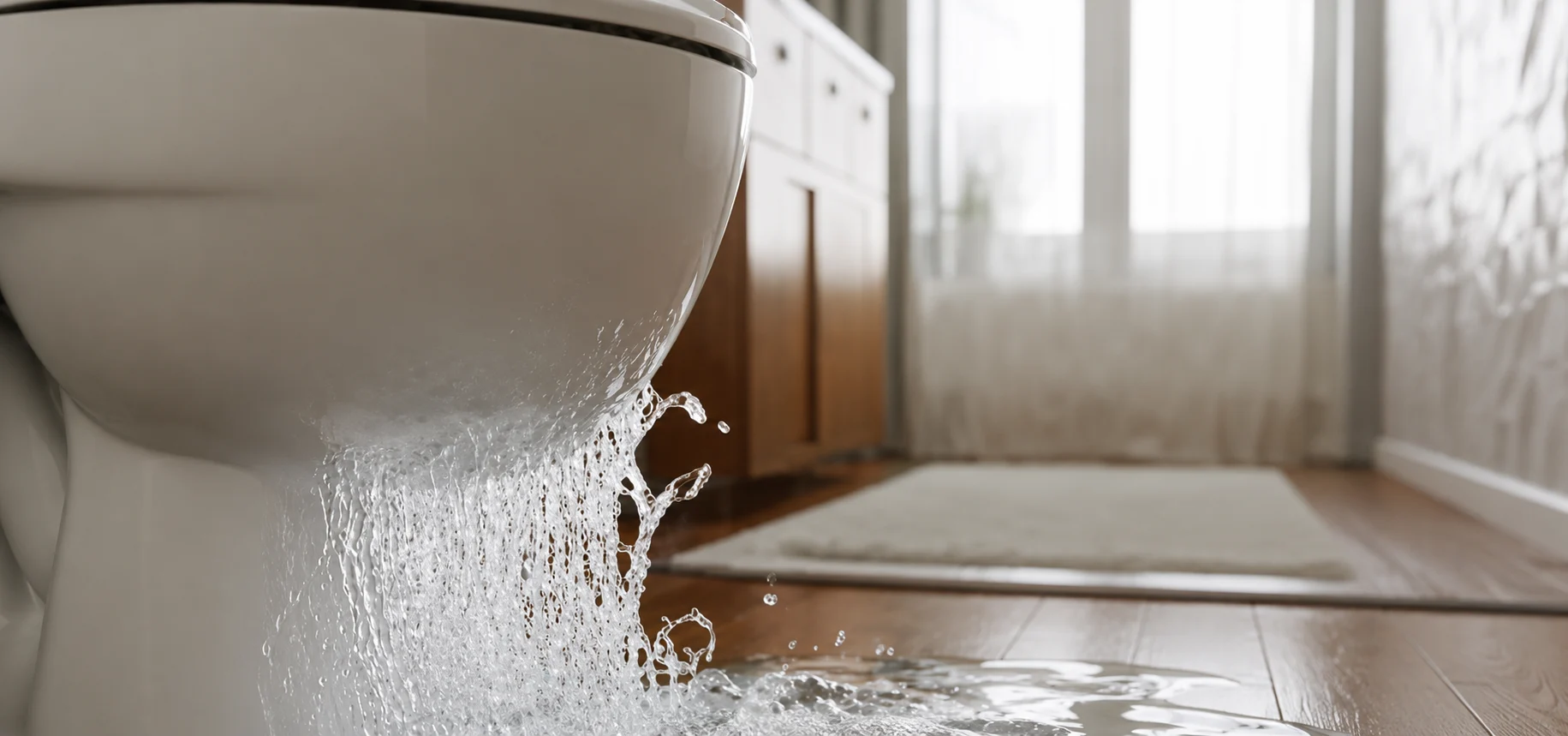
What to do the moment a drain backs up
The first few minutes decide how bad it gets. Almost all of it comes down to one thing: stop adding water.
Quick answer
What should I do first when a drain backs up?
The moment a drain backs up, stop using all water that feeds that drain: taps, the washing machine, the dishwasher, and above all avoid flushing toilets on that line. Every litre you add has nowhere to go and makes the backup worse. Stopping water use is the single most important thing you can do before help arrives.
First: stop adding water
When a drain backs up, there is a blockage downstream and the water already in the system has nowhere to go. The instinct is often to run more water to push it through, or to keep using other fixtures because they seem fine. Both make it worse. The single most important thing, before anything else, is to stop using every fixture that drains into the blocked line. That means taps off, no running the washing machine or dishwasher, and critically, no flushing toilets on that line, because a toilet flush into a blocked drain is exactly how a backup becomes an overflow of the worst kind. Every litre added has nowhere to go and comes back up somewhere you do not want it.
Then: contain and protect
Once you have stopped adding water, the next priority is limiting the damage from what has already come up or is about to:
- Move what you can away from the affected area, especially in a kitchen or bathroom where water may spread.
- If water is backing up near electrical sockets or appliances, treat it as a safety matter and keep clear, isolating power to that area if you can do so safely.
- If the backup is sewage rather than clean water, treat it as a health hazard: keep people and pets away and avoid contact. This is a sewer emergency and is more urgent than a clean-water backup.
- Contain the spread with towels or a barrier if you safely can, to keep it from reaching other rooms.
What not to do, and when to call
A few instincts make things worse. Do not pour chemical drain cleaner into a fully backed-up drain: it will not clear a real blockage, it sits in the standing water, and it creates a hazardous splash when the drain is finally cleared. Do not keep testing whether it has cleared by running water or flushing, since each test adds to the problem. And do not ignore a backup affecting multiple fixtures at once, hoping it clears itself, because several fixtures backing up together points to a main or shared line problem that will not resolve on its own.
Call for help when the backup does not clear once you have stopped adding water, when it affects more than one fixture, when it is sewage, or when it is actively overflowing. These are emergency situations where the wait is the expensive part, which is what a 24 hour service is for. When you call, say what is backing up, whether it is one fixture or several, and whether it is clean water or sewage, so the right response comes to you. The calm version of this whole checklist is really one instruction: stop adding water, keep people safe, and get the blockage cleared properly rather than fought with.
Frequently asked questions
Why does adding more water make a backed-up drain worse?
Because a backup means there is a blockage downstream and the water already in the system cannot get past it. Every additional litre, from a tap, an appliance, or especially a toilet flush, has nowhere to go, so it raises the level and comes back up, turning a contained backup into an overflow. This is why stopping all water use on the affected line is the single most important first step, ahead of anything else, when a drain backs up.
Should I use chemical drain cleaner on a backed-up drain?
No. Chemical cleaner will not clear a real blockage in a fully backed-up drain; it simply sits in the standing water, and it creates a hazardous chemical splash when the drain is finally cleared by hand or machine. It can also damage pipes. For a drain that is completely backed up, the safe and effective step is to stop adding water and have the blockage cleared properly, rather than pouring in chemicals that do not reach or shift the actual obstruction.
When is a drain backup an emergency?
Treat it as an emergency when it does not clear after you stop adding water, when it affects more than one fixture at once, when it involves sewage rather than clean water, or when it is actively overflowing into the property. Multiple fixtures backing up together points to a shared or main line problem that will not resolve itself, and a sewage backup is a health hazard. In these cases the wait is the costly part, which is what an emergency and 24 hour service exists to remove.
How do I find a drainage company near me for this?
We work across Dubai, so near me is less about a branch nearby and more about coverage. If you searched for what to do the moment a drain backs up near me, you are looking for someone in Dubai who handles the kind of issue this article describes, and we do. We work across the city from our base in Al Quoz Industrial Third, so wherever you are, the question is how soon we can attend, which depends on your location and the time. Tell us what is happening with what to do the moment a drain backs up and roughly where you are, and we will give you a realistic response time. A near me search is really a request for help that can actually reach you, and across Dubai, it can.
Related pages
Contact
Ask us about it
Describe what is happening and we will tell you how we would approach it.
Phone
+971 56 864 8994
Email
info@jetdrainpro.com
Have a drainage problem like this?
Tell us what your drain is doing and where. We work across Dubai from our Al Quoz base.