
How drain camera inspections work
What actually happens when a camera goes down your drain, and how a fault gets a location.
Quick answer
How does a drain camera inspection work?
A drain camera inspection sends a waterproof camera through the pipe, either on a flexible rod for short runs or on a powered crawler for larger ones. It transmits live video to a screen while recording, and a transmitter in the camera head, called a sonde, lets a fault be located and its depth measured from the surface.
The equipment
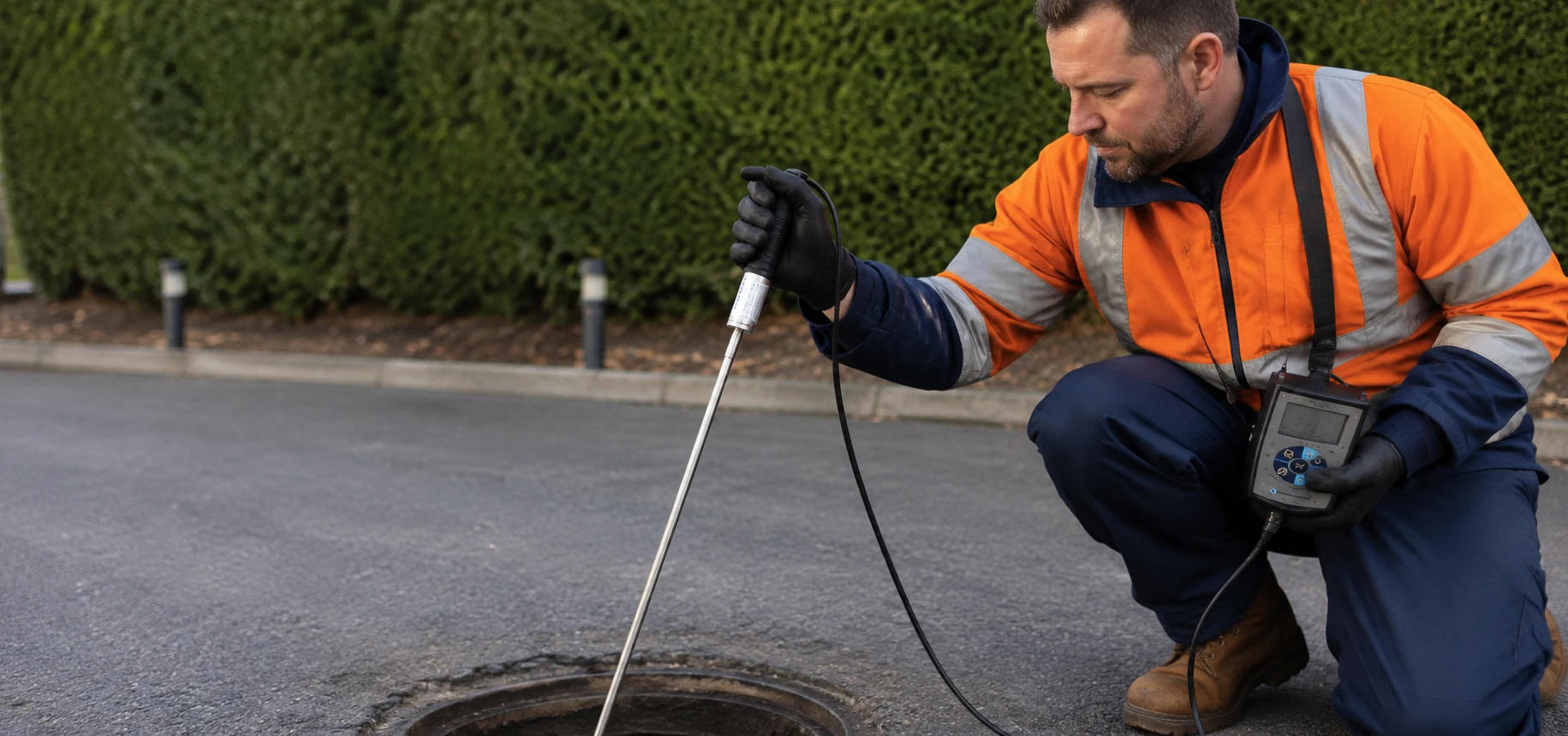
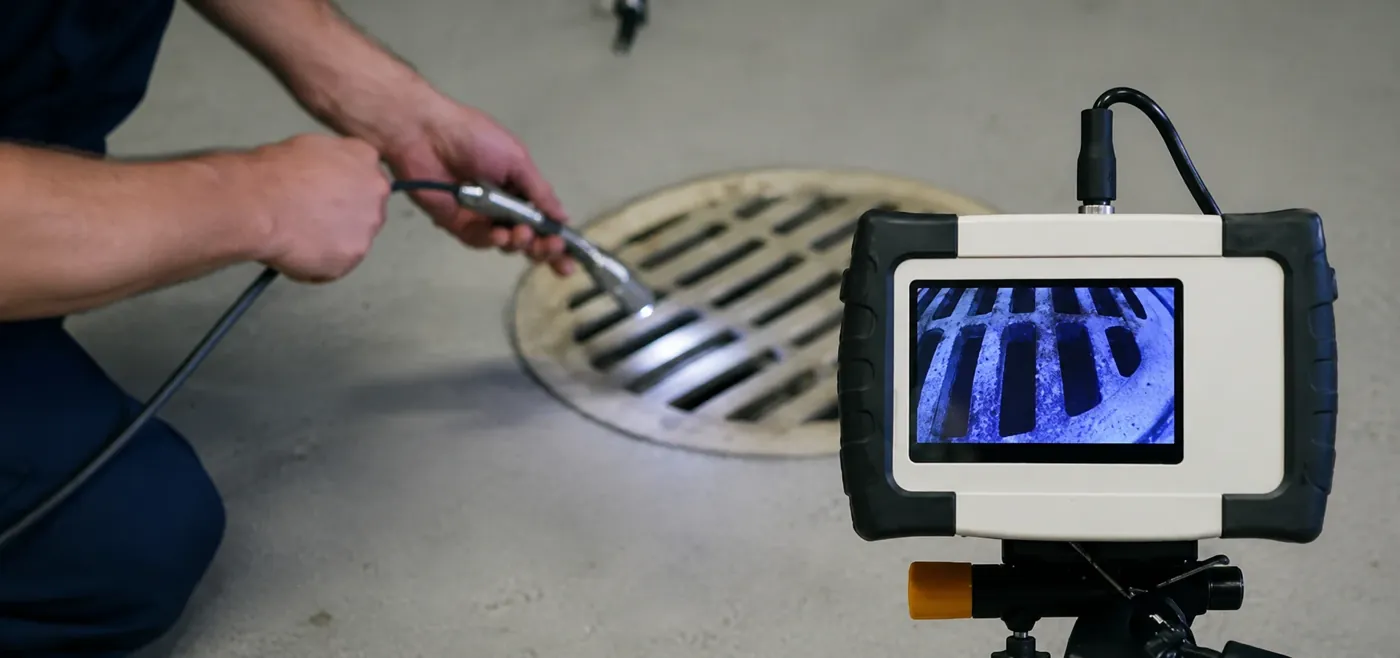
A drain inspection uses a waterproof camera with its own light, sent down the pipe in one of two ways. For short domestic runs, the camera sits on the end of a flexible push rod that is fed in by hand from an access point. For larger and longer lines, it rides on a powered crawler, a small tracked or wheeled unit that drives itself along the pipe under the operator's control. Either way the camera sends live video back to a screen at the surface, and the whole run is recorded.
The piece that makes a survey more than a video is the sonde: a transmitter built into the camera head. It emits a signal that a locator held at the surface can detect, which means a fault seen on the screen can be pinpointed on the ground above and its depth measured. Without it, you would know a pipe had a defect but not where to dig for it. With it, a fault becomes a marked spot and a depth.
How a fault gets a location
Two numbers turn a picture into something you can act on. The first is distance along the pipe: the equipment measures how far the camera has travelled, so an observation is recorded not just as a crack but as a crack at, say, 8.4 metres from the chamber. The second, where excavation is likely, is the surface position and depth, found by tracing the sonde. Together they mean a repair crew can go straight to the fault, dig once, and reach it, instead of trenching along the line hoping to find it.
This is the difference between a survey and a look. Anyone can push a camera down a pipe and see a problem. A proper survey records where each problem is, so the report can be used by someone who was never on site, including a second contractor for an independent quote. Location is what makes the survey evidence rather than an impression.
What the operator is reading
A skilled operator is not just watching for a blockage. They are distinguishing a service fault, grease, scale, sand, from a structural one, a crack, a displaced joint, back-fall, because the two lead to completely different work. They are noting the pipe material and diameter, reading the fall from how water sits and moves, and identifying connections and changes of direction. The camera provides the image; the value is in reading it correctly, which is why the inspection and the report that follows are a skilled job rather than an automatic one.
Frequently asked questions
What equipment is used for a drain camera inspection?
A waterproof camera with its own light, sent through the pipe either on a flexible push rod for short domestic runs or on a powered crawler for larger lines. It transmits live video to a surface screen while recording the whole run. The camera head also contains a sonde, a transmitter that lets a locator at the surface pinpoint a fault's position and depth, which is what allows a defect to be found again for excavation.
How does a drain camera locate a fault for digging?
Through a sonde, a transmitter in the camera head. When the camera reaches a fault, the operator traces the sonde's signal from the surface with a locator, marking the position on the ground above and reading the depth. Combined with the recorded distance along the pipe, this means a repair can be dug in exactly the right place, once, rather than by exploratory trenching along the line, which on a driveway or garden is a large saving.
Can a drain camera go around bends?
Yes. A flexible push rod negotiates the bends in domestic waste pipes, and a crawler is designed to travel through the larger bends and junctions of sewer lines. Very tight or damaged bends can limit how far a camera passes, which is itself useful information, since a camera stopping at a consistent point can indicate a collapse or severe displacement at that location worth investigating.
What is the difference between a drain camera and a proper survey?
A camera provides the image; a survey records and interprets it. Anyone can push a camera down a pipe and see a problem, but a proper survey logs where each observation is by distance, distinguishes cleaning faults from structural ones, notes pipe material and condition, and produces a report a second contractor could act on without having been there. The equipment is the same; the value is in the recording, the location and the reading, which is what makes a survey evidence.
Is how drain camera inspections work available near me?
Near me is a fair thing to search for, and here is how it works with us. We provide how drain camera inspections work across Dubai, working from our base in Al Quoz Industrial Third, so a near me search is answered less by a branch on your street and more by how quickly we can reach you. That depends on where you are in the city, the time of day and access, so rather than claim to be the nearest, we ask where you are and give you a realistic time to attend. Tell us your location and what you need, and we will be straight about when we can be there.
Related pages
Contact
Book an inspection
For a purchase, a repair quote, a recurring blockage or maintenance. Tell us the building and the line.
Phone
+971 56 864 8994
Email
info@jetdrainpro.com
Want your drain surveyed?
Tell us the line and why you need it looked at. We will scope a survey and a report to match.